Showing posts with label Roof Anchor. Show all posts

Thursday, March 3, 2011

Working With Concrete

In the roof anchor business, it doesn't matter if its retrofit or new construction. Reinforced concrete is the best of the best when it comes to a structure to work with. It's more cost effective, doesn't typically require localized reinforcing or access to the underside of the structure. It also has a host of other benefits as well such as improved insulation and sound barrier qualities.

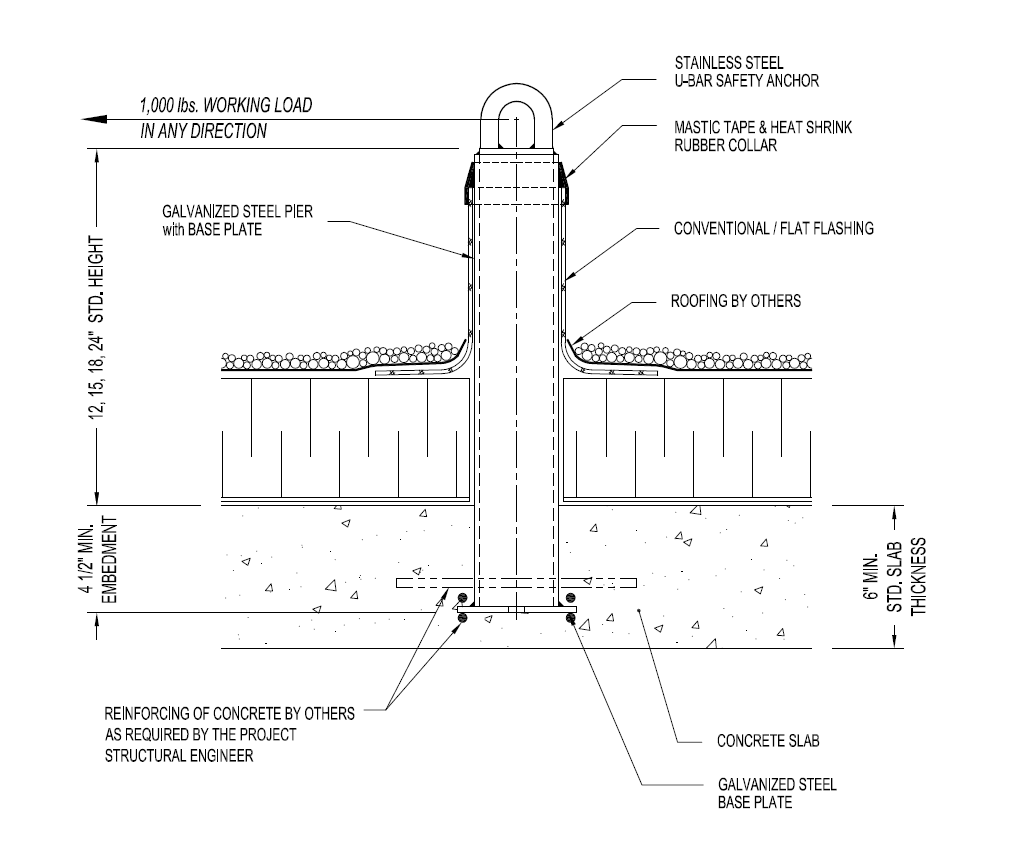
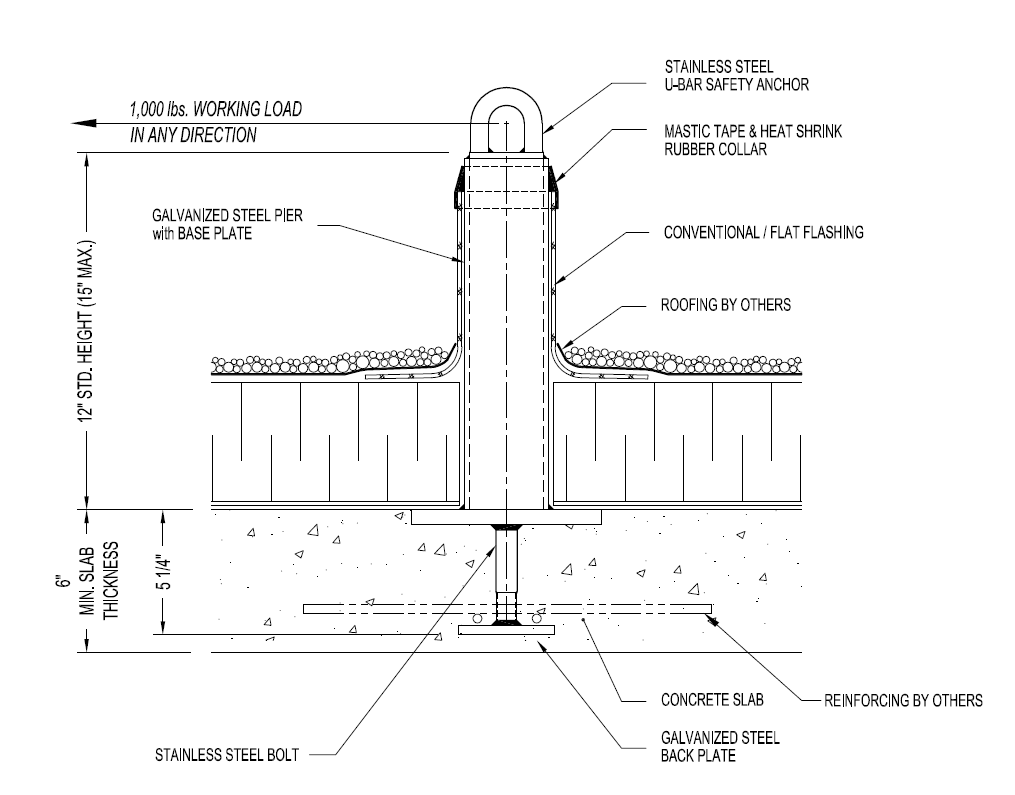
The best part in new construction is that we don't have to send anybody to the site for installation which saves everybody time and money. We simply send the anchor to the site with our shop drawings and the anchors are cast in place. There are three types of cast in anchors: single stud, four stud, and fully embedded.

Single stud are the most difficult to physically place for casting in as they only have one bolt from which to balance the anchor.


Four stud are much easier to cast in. As you can imagine they have four studs or bolts from which to vertically support the anchor. These extra three studs are required by engineering for taller anchors.


 And finally we come to fully embedded. This is my personal favorite for two reasons: one its very east to stand up for casting, two, it is more cost effective than both the single and four stud anchors.


In the unfortunate event that a pour is missed by the roof anchor manufacturer and the anchor have to be retrofitted, its not as bad as you think. We simply have use an adhesive anchor and glue, or epoxy the roof anchors into place.


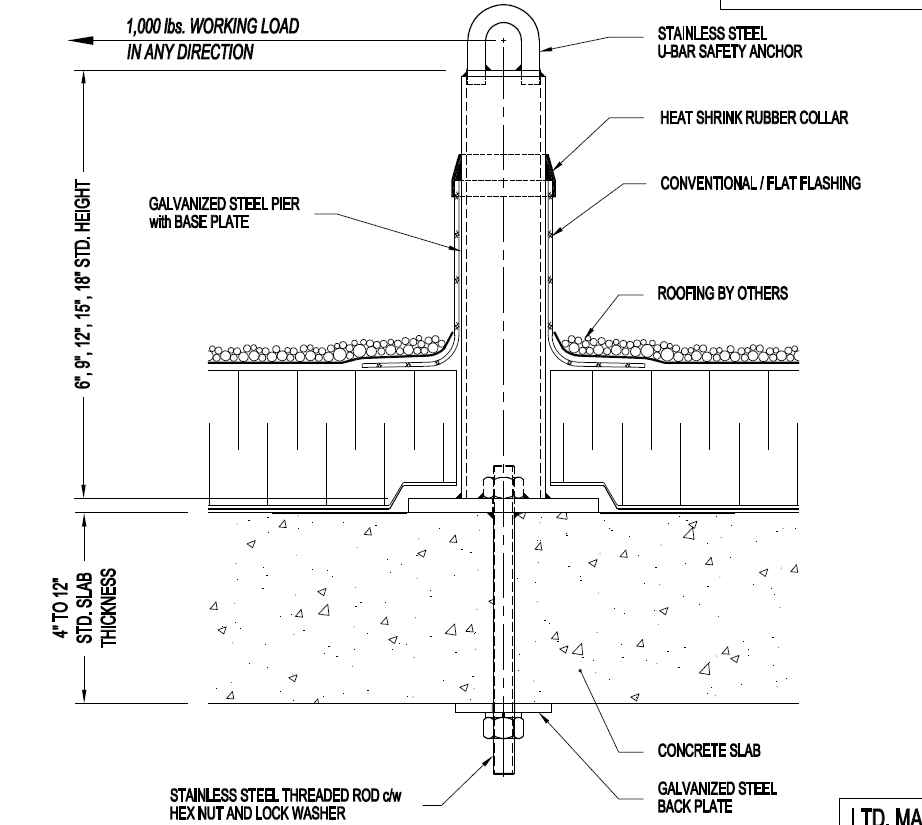
There is also an option of using a bolt through style anchor in the chance happening that is pour is missed to retrofit the anchor it but I would not recommend it. The bolt through style anchor requires access to the underside of the structure to complete installation and it also requires leaving a plate exposed.


For its strength and forgiving nature, concrete is definitely the structure of choice for roof anchor manufacturers.

Best,


Michael Gray
Marketing and Sales Support
Ontario and Eastern Canada
Pro-Bel Enterprises Ltd
e: mikegray@pro-bel.ca
t: @Pro_Bel
w: www.pro-belgroup.com

Monday, February 28, 2011

Retrofitting Roof Anchors

It's always better to have window washing, suspended maintenance and fall protection systems installed in new construction. But far too often, builders attempt to save the client money on construction costs without due consideration of retrofit. There are a number of reasons to avoid retrofitting these systems when at all possible:
  • it is a lot more expensive
  • will require penetrating the roofing assembly and possibly voiding existing warranty
  • intrusive; retrofitting can require gaining access through suites to get on to balconies and terraces
  • construction work during occupancy can disrupt the day to day operation and enjoyment of the building and tenants units
  • reinforcing of the structure may be required
  • cutting open the ceiling in tenants units may be required
Unfortunately, buildings everyday require retrofit of roof anchor systems for a number of reasons. They may be very old, the current system may be deficient, or the building may simply have never had a system installed. When it is decided in these cases that a system will be installed there are some things the building owner can do to reduce the inconveniences of retrofitting.

Dig Up The Drawings

Search everywhere you can to try and locate the as built architectural and structural drawings. If the window washing system manufacturer has full sets of drawings he may not need as much or any access to private suites and terraces thus eliminating the need to inconvenience tenants at the design stage. Keep in mind, access will still be require to perform the installation and for annual inspections. Note: If this particular building already has anchors, there is a good chance that a drawing of this anchor system is posted at the roof access point.

Roof Warranty

Check to see if there is an existing warranty in effect on the roof. If there is, have that roofer do all the patch work for the roof anchor systems installation otherwise the exsting warranty may be voided. If there is no warranty, make sure the roof anchor contractor will provide it's own roofing contractor. It is also worth considering having your anchor system installed at the same time as re-roofing.

Suite Access

If the roof anchor contractor tells you that suite access is required, make sure that tenants are aware of the exact date the site walkthrough occur. This way the roof anchor contractor and building super are not met with any resistance when entering tenants units.

Tender

It is prudent to tender the job out as opposed to having one company look at your building and provide a quotation. This will help to ensure that the prices provided remain competitive. I would not recommend hiring a consultant to handle the tender process unless the size of the project is substantial.

Window Washing Or Suspended Maintenance?

One of the most important things to understand is what type of system is being proposed by the roof anchor contractors. Clarify if you want window washing only or the ability to suspend swing stages for facade work. The difference in cost and functionality can be quite significant.

Knowledge is power. At the end of the day knowing and understanding more will serve to save money and headaches from getting quotes to supervising the construction of the job.


Best,

Michael Gray
Marketing and Sales Support
Ontario and Eastern Canada
Pro-Bel Enterprises Ltd
e: mikegray@pro-bel.ca
t: @Pro_Bel
w: http://www.pro-belgroup.com/

Thursday, February 24, 2011

Working With Hollow Core Precast


Every type of roof structure presents its own unique challenges in new construction for companies who supply and install permanent equipment on them. With structural steel its reinforcing, with concrete it can be missing a pour. Hollow core precast can be looked at as one of the most challenging roof construction types for the installation of window washing, suspended maintenance and fall protection systems.

The main issue with precast lies with the fact that there usually is no drop ceiling underneath. It's quite often stucco and even plaster which means bolting through the structure would require leaving a backplate exposed to view at the underside of the precast. Not only is this not aesthetically pleasing, it also presents a potential danger to the workers who use the roof anchors as the base securement of the anchors is exposed and could potentially be tampered with. This provides us with two options: cracking open the cores and grouting the anchor in or having the precast manufacturer embed plates.

Grouting A Roof Anchor Into Hollow Core Precast


This option requires two cores to be broken open and embed plates at bottom of the bolts to be cast in with rebar and grouting. This prevents from having to bolt through the structure but is very labour intensive and thus costly. Ideally in new construction the roof anchor company would supply only this anchor and leave it up to the general contractor to break open the cores and grout the anchor in. Grouting in hollow core is quite common.

Having The Precast Manufacturer Embed A Plate


This option although the most cost effective when you can't bolt through, is unfortunately very impractical and rarely used. An embed plate is sent to the precast manufacturer along with an engineered stamped layout showing the location of the roof anchors on the roof plan. The precast manufacturer then embeds this plate in to the hollow core structure at the appropriate locations. The roof anchor manufacturer goes to the site afterwards and welds the pier and u-bar in place. The problem with this approach is that the precast manufacturer will usually not want to take responsibility for casting the embeds in.

At the end of the day bolting through is the best way to go but when you can't here are a few options for you to consider.


Michael Gray
Marketing and Sales Support
Ontario and Eastern Canada
e: mikegray@pro-bel.ca
t: @Pro_Bel
w: http://www.pro-belgroup.com/

Tuesday, February 22, 2011

Product Profile: The Roof Anchor


There are many different types of permanent equipment that is installed on roof tops for window washing, suspended maintenance and fall protection including roof anchors, wall anchors, soffit anchors, davits, rigging sleeves, horizontal trolley's, monorail, gantry's and roof cars.  With all the fancy equipment out there, nine times out of ten it is a simple roof anchor that gets the job done.

Different companies around the world use different styles of roof anchors each unique in their own way. The vertical HSS, known as the pier, are all pretty much the same but the actual tie-off or anchorage point can vary. Some companies utilize a swivel head u-bar that actually points horizontal (perpendicular) to the pier and can swivel, others have fixed "u-bars" or "eyelets" that point vertical such as in the pictures shown above. The material's used from pier, u-bar and hardware can vary in material from galvanized to stainless steel depending on the project specifications although stainless steel piers are not used very often due to cost.

These anchors are installed to accommodate three different styles of systems: fall protection, window washing, and suspended maintenance.

Fall Protection

Workers can utilize either individual anchor points, or a horizontal lifeline cable system to prevent them from falling (travel restraint) or save them from hitting the ground (fall arrest) in the event they do fall.


Window Washing

Window cleaners can utilize roof anchor points to suspend themselves adjacent to the building facade to perform window cleaning operations. This is commonly done a bosun's chair but is also performed on swing stages as well.


Suspended Maintenance

Companies performing facade maintenance such as brick restoration, window caulking or balcony repair can utilize roof anchors to suspend the platform that they work from.


Often the simplest approach is the best one. Window washing, suspended maintenance and fall protection systems are no exception.


Michael Gray
Marketing and Sales Support
Ontario and Eastern Canada
Pro-Bel Enterprises Ltd
e: mikegray@pro-bel.ca
t: @Pro-Bel

Thursday, February 17, 2011

Roof Anchor Inspections

Like many other products in the construction industry, window washing, suspended maintenance and fall protection systems must undergo periodic inspection to ensure that they are in working order. The inspection frequency is dependent on the local regulations but typically they are required to be inspected no less than once a year. If you are a roofer, restoration contractor, window washer, property management company or building owner, there are some things you should know.

Who Can Perform These Inspections?

Again, the qualifications of a roof anchor inspector can vary from province to province and state to state, but typically these inspectors perform their duties under the supervision of an engineer. What this means is that the company that employs the inspector must have on staff, a licensed engineer who is willing to take responsibility for the anchor system reports of the inspectors. This engineer must train the inspector in exactly what to look for and how to write detailed reports on their findings. The inspector does not necessarily have to be an engineer but this is sometimes the case.  Obviously the manufacturer of the equipment is suitable to perform these inspections, however, there are also other companies such as engineering firms that can do the work.

What Is Involved In An Inspection?

When an inspector goes to a building, he or she is not necessarily there to review the design or layout of the roof anchor system (although this is not always true), they are more there to review the integrity of the system. This includes:
  • performing a visual inspection looking for: signs of rust or corrosion; improper flashing; code compliant anchors installed; an up to date as built shop drawing posted at the roof access point; examining previous reports and log books; obvious fall hazards
The inspector may also test the approximate structural integrity of the roof anchors by hitting them with a rubber mallet to see if the anchors have any give to them.

After the inspection is completed, a report with either a passing or failing grade is sent to the building owner or property management company for there review. If the system is passed, it is safe for use. If the system contains deficiencies preventing it from being compliant, the inspector should provide a list of recommendations on how these problems can be corrected. This system may not be legally used until it has passed inspection.

What Is Pull Testing?

Window washing and fall protection systems that utilize an adhesive securement type to secure to the roof structure must periodically undergo a process called pull testing. Typically it is required every five years but this may vary in different jurisdictions. Adhesive anchors essentially use glue to secure themselves to an existing concrete structure. The pull testing process places a lateral load on the anchor to ensure that the glue is still holding up. Sometimes on very old roof anchor systems, or systems with no as built shop drawings, the anchors are pull tested regardless of the securement type just to make sure the structural integrity of the anchors is still intact. Pull testing can typically be performed by the same companies that do the inspections.

How Expensive Is It?

The cost of inspection can vary greatly depending on how sophisticated the system is, where the building is located and if there is suite access required.  Building owners or property management companies that represent several buildings can save money by awarding contracts to the same inspector for several buildings, and by signing up for multiple year contracts.

I Have Window Washing Equipment On A Tenant's Terrace or Balcony

Sometimes there is nothing that can feasibly done to avoid this. If this is the case on your building, you must arrange access through the unit tenants suite for the roof anchor inspector. The inspector will require access to ALL terraces and balconies that contain window washing equipment.


At the end of the day, building owners and property managers should make sure window washing, suspended maintenance and fall protection systems are inspected every year regardless of use. If the system did not pass the most recent inspection, deficiencies are not corrected and the owner allows someone on to the roof top, they are liable for anything unfortunate that could happen. The value of piece of mind is definitely with the low cost of having an inspection done.


Michael Gray
Marketing and Sales Support
Ontario and Eastern Canada
Pro-Bel Enterprises Ltd
e: mikegray@pro-bel.ca
t: @Pro-Bel

Tuesday, February 15, 2011

Retrofitting Solar Panels on Flat Roofs

Solar energy is increasingly becoming ever more popular world wide as an alternative means to producing usable energy. Many installations are taking place on highrise apartment and condominium buildings in an effort to reduce both the carbon footprint of the building as well as operation costs. On many of these building rooftops, there are a series of existing systems already in place. Roof drains, vents, mechanical equipment, cell towers, etc... Not the least of which are window washing, suspended maintenance and fall protection systems. Roof anchors.

In order for a roof anchor system to function properly, the anchor point locations are calculated and engineered very precisely. Obstructing or covering up roof anchor points, can void the validity of the window washing system. Thus, when solar manufacturers or installers are considering placing units on roof tops with anchor systems, they should immediately consult a reputable manufacturer to determine the roof anchor implications of adding solar equipment.

Many companies are glad to help. Window washing system manufacturers can review building drawings and determine 'safe zone' locations for the panels to be installed that won't affect the layout of the roof anchor system. Many will also attend site visits and review as built conditions free of charge.

When solar panel supports are vertical HSS tubes permanently secured to the roof, you may want to consider having a roof anchor manufacturer to supply and install. These supports very often are exactly the same as a roof anchor, just without the eye / u-bar on the top. Some manufacturers can also weld a u-bar onto the side of the vertical HSS post thus allowing the solar panel supports to double as roof anchors.

One more thing to consider when placing solar panels on roof tops is the proximity of the panels to the roof edge. If the roof parapet is low, and the panels are close to the edge, workers who have to traverse these areas are placed in a fall hazard situation. Fall protection systems should be installed in these areas to protect workers performing routine roof  or panel maintenance. Generally, workers should be tied off to fall protection systems when they are within 6' of a parapet that is 36" or shorter, and exposed to fall of 10' or more.


Michael Gray
Ontario and Eastern Canada
Marketing and Sales Support
Pro-Bel Enterprises Ltd
e: mikegray@pro-bel.ca
t: @Pro_Bel
Monday, February 14, 2011

Specifying Window Washing and Fall Protection Equipment

Roof anchor systems can be designed for a series of different purposes. Mainly, they are used for fall protection, as supports / lifelines for window washing, or as supports / lifelines for suspended maintenance (swingstage) work. With these different functionalities, it is important that the specifications describing this scope of work accurately reflect the intended design of the system. Far too often a general spec is put out and it is not relevant to the individual projects needs at all. This can create confusion, and additional costs for the owner or general contractor.

This particular blog is intended to examine the key areas of the specifications that commonly are not well written and offer suggestions on how they could be improved to eliminate confusion and save time and money.

The Title of Specification

The title of the specification should reflect the intended design of the system. For example, if the system is designed to be used for fall protection only, the specification should not be titled, "Window Washing Systems", it should more accurately be titled "Fall Protection Systems". Besides the obvious incorrect title, this situation creates another problem. Although the roof anchor system may be clearly designed for fall protection only, since the system specification is titled "Window Washing Systems", the owner or general contractor thinks that they are getting just that.

Part 1: General Requirements, Section Includes

This particular section of the specification is a fantastic opportunity for the specifier to place a written description of the design intent for the roof anchor system in plain view. This way, the bidders have an understanding of exactly what kind of system the owner is looking for. Far too often a generic description or a description for the wrong type of system is placed here. Below, find an example of a description for a fall protection only roof anchor system.

The intent of this scope of work is to design, supply and install an engineered fall protection only system. All window washing and exterior facade maintenance operations are to be carried out from ground level.

Manufacturer Qualifications

Window washing, suspended maintenance and fall protection is a huge industry. There are a ton of companies that supply this equipment. The specifier should use this opportunity to place requirements in this section that will solicit bids from only the most qualified of companies. The bidder should have sufficient liability insurance, errors and ommissions insurance, have a minimum of five years documented experience in the industry, and specialize in this type of equipment.

This criteria will eliminate the possibility of miscellanous steel fabricators bidding on this scope of work. These companies are not qualified to bid on fall protection, window washing, or suspended maitnenance systems. Handling this scope of work comes down to more than just fabricating the equipment.

Part 2: Products, Equipment

There are many different ways to skin a cat. With a concrete structure for example you could supply a cast in place single stud roof anchor, a fully embedded roof anchor, bolt through after the pour, or use an adhesive anchor after the pour. Every option has its advantages and disadvantages. This is a great opportunity for the specifier to evaluate which type of equipment is best suited to the job and place it here. If the wrong type of equipment is listed and can result in a needlessly more expensive system and create confusion.

Reinforcing

If the roof support structure is steel beams and joists, the areas in which the roof anchors are installed will need to be reinforced. It should be clearly stated in both the steel and fall protection trades specification that the structural steel trade is responsible for this. If you want to learn more about this please read my previous blog posting on reinforcing roof anchors and steel structure.


At the end of the day, writing specifications for window washing, suspended maintenance and fall protection can be very tricky. I would highly recommend seeking out assistance fomr a reputable manufacturer. They typically will not charge to help out with writing specifications as long as they are listed as a bidder.


Michael Gray
Ontario and Eastern Canada
Marketing and Sales Support
Pro-Bel Enterprises Ltd
e: mikegray@pro-bel.ca
t: @Pro_Bel

Thursday, February 10, 2011

Roof Anchors / Reinforcing Steel Structure

In Ontario, Canada most high rise buildings, residential and commercial, are constructed with reinforced concrete floors and columns.  On shorter buildings, usually commercial, industrial or schools, the roof structure is steel and comprised of beams and joists. When permanent fall protection systems are installed on this type of roof structure, often the locations are required to be reinforced. The reinforcing method typically used is whats called an "H-frame". See this article written by Canam for more information: http://www.canam-steeljoist.ws/www/v4/newslet.nsf/va_redir/joistv5n2

A few common issues with reinforcing are
  • anchor locations are not shown on the structural drawings
  • anchor locations do not show reinforcing on the structural drawings
  • reinforcing responsibility is not clearly assigned to a scope of work in the specifications
  • reinforcing methodology is not clearly detailed in the drawings
When the specifications are written and reinforcing of roof anchor locations is not addressed, a number doesn't get carried at the time of tender and the result is a hefty extra to the building owner or general contractor.

Another common situation is when the architects put the reinforcing into the window washing / fall protection manufacturers scope of work.  When this happens and reinforcing is not detailed, the window washing manufacturer may price the reinforcing and get the contract, but at the end of the day when shop drawings are submitted the structural steel trade may reject the methodology and the result is dispute over who pays for the extra.

Architects can save time, confusion and money by ensuring that they:
  • consult a structural engineer on the issue of reinforcing of the roof structure
  • show the anchors on both the architectural roof plan and structural roof framing plan
  • show the locations of reinforcing on the framing plan
  • detail methodology of reinforcing in the drawings
  • clearly assign the reinforcing scope of work to the structural steel trade in both their spec, and the fall protection manufacturers spec
In Ontario we generally require the roof structure to be reinforced to a 5,000 lbs ultimate load. For new construction, leave the anchors to the anchor guys and structure to the structural guys.

Michael Gray
Marketing and Sales Support
Ontario and Eastern Canada
Pro-Bel Enterprises Ltd
e: mikegray@pro-bel.ca
t: @Pro_Bel